

Contact us to Apply for one of these Red Toy Poodle puppies
The history of Red Toy Poodles
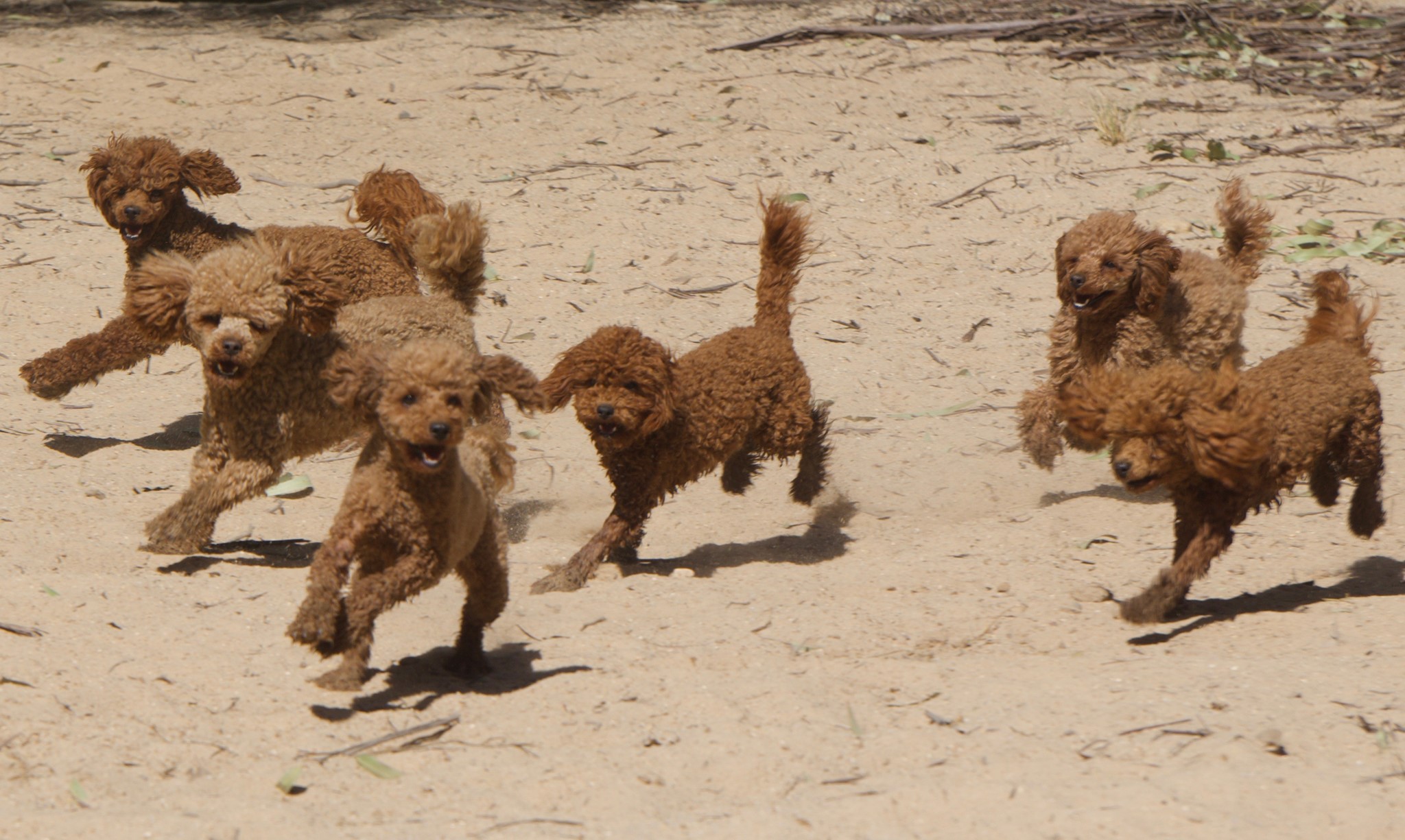
Red poodles are rare and are of a faded gene.
When they are produced, the pups usually come from dogs with apricot lines, which can be confusing to many since of course red is a much darker and deeper color.While the DNA of red poodles still needs to be better understood, they do appear to be of a completely separate gene, sometimes referred to as the “rufus” gene.This gene may work to darken an apricot (or sometimes a brown) coat.One thing that is clear is that the red gene has absolutely no affect on blacks. The apricot gene is recessive to all Poodles except for the white.Experimental breeding was done by mating a small miniature apricot female Poodle to a large standard sized red at Palamares.
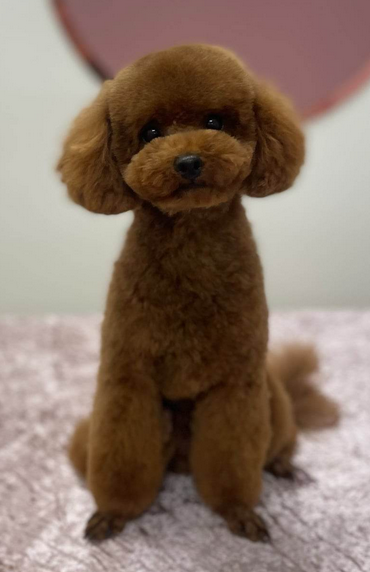
The Poodle, called the Pudel in German and the Caniche in French, is a breed of water dog. The breed is divided into four varieties based on size, the Standard Poodle, Medium Poodle, Miniature Poodle and Toy Poodle, although the Medium Poodle is not universally recognised. They have a distinctive thick, curly coat that comes in many colors and patterns, with only solid colors recognized by breed registries. Poodles are active and intelligent, and are particularly able to learn from humans. Poodles tend to live 10–18 years, with smaller varieties tending to live longer than larger ones.
The Poodle likely originated in Germany, although the Fédération Cynologique Internationale (FCI) and a minority of cynologists believe it originated in France. Similar dogs date back to at least the 17th century. Larger Poodles were originally used by wildfowl hunters to retrieve game from water, while smaller varieties were once commonly used as circus performers. Poodles were recognized by both the Kennel Club of the United Kingdom and the American Kennel Club (AKC) soon after the clubs’ founding. Since the mid-20th century, Poodles have enjoyed enormous popularity as pets and show dogs – Poodles were the AKC’s most registered breed from 1960 to 1982, and are now the FCI’s third most registered breed. Poodles are also common at dog shows, where they often sport the popularly recognized Continental clip, with face and rear clipped close, and tufts of hair on the hocks and tail tip.
History

Most cynologists believe the Poodle originated in Germany in the Middle Ages, from a dog similar to today’s Standard Poodle. The Poodle was Germany’s water dog, just as England had the English Water Spaniel, France the Barbet, Ireland the Irish Water Spaniel and the Netherlands the Wetterhoun.[1][2][3][4][5] Among the evidence used to support this theory is the Germanic name for the breed, Poodle or “Pudel” in German, which is derived from the Low German word “puddeln”, meaning “to splash”. Numerous works by various German artists from as early as the 17th century depict dogs of recognisably Poodle type.[1][2][3][5] Some cynologists believe the Poodle originated in France, where it is known as the “Caniche” (French for “duck dog”), and that the breed descends from the Barbet. This view is shared by the Fédération Cynologique Internationale (FCI).[6][7] Others argue that the breed originated in Russia, Piedmont or Northwest Africa.[4][7]
Whatever the Poodle’s country of origin, both their German and French breed names indicate the modern Poodle’s ancestors were widely used by waterfowlers both to retrieve shot game and to recover lost arrows and bolts that had missed their mark.[3][4]
About the Breed
Despite his diminutive size, the Toy Poodle stands proudly among dogdom’s true aristocrats. Beneath the curly, low-allergen coat is an elegant athlete and companion for all reasons and seasons.
Poodles come in three size varieties: Standards should be more than 15 inches tall at the shoulder; Miniatures are 15 inches or under; Toys stand no more than 10 inches. All three varieties have the same build and proportions. At dog shows, Poodles are usually seen in the elaborate Continental clip. Most pet owners prefer the simpler Sporting clip, in which the coat is shorn to follow the outline of the squarely built, smoothly muscled body. Forget any preconceived notions about Poodles you may have: Poodles are eager, athletic, and wickedly smart dogs of remarkable versatility. The Standard, with his greater size and strength, is the best all-around athlete of the family, but all Poodles can be trained with great success.
History of the breed.
The Poodle is the national dog of France, and the French sure do love their Poodles. There is, however, no such breed as the “French Poodle.” In France, Poodles are known as the Caniche, or “duck dog.”
Despite the Poodle’s association with France, the breed originated as a duck hunter in Germany, where the word “pudelin” refers to splashing in water. The Standard Poodle began its development as a retrieving water dog more than 400 years ago. With a crisp, curly coat as protection against the elements, superlative swimming ability, and off-the-charts intelligence, the Poodle was, and still is, a magnificent retriever. (The Standard is the only breed classified as a non-sporting dog that is eligible for AKC Retriever Hunting Tests.)
The flamboyant Poodle show coat served a practical purpose in the breed’s early years. Hunters wanted their dogs to have free range of movement in the water, but they also wished to protect vital areas of the anatomy from the cold. They shaved the legs, neck, and tail but left the chest, hips, and leg joints coated. The rounded tufts on the legs, hips, and tail tip are called pompons. (Note the spelling: Cheerleaders have pom-poms; Poodles have pompons.)
The Poodle’s many fine qualities allowed it to move from the lake to the lap of luxury. Elegant Poodles of the Standard and Miniature varieties found favor among the nobles of France and, eventually, all of Europe. The breed’s showy looks and trainability made it a natural entertainer, and Poodles have long been associated with the European circus tradition. An excellent nose brought the Poodle additional work as a truffle hunter.
The Standard was bred down to the Miniature. The Toy was first bred in America, in the early 20th century, as a city-dwelling companion dog. Well-bred specimens of each variety are exact replicas of each other and are bred to the same standard.
Many thanks to the https://www.akc.org/dog-breeds/poodle-toy/ for this amazing information
 Cocobo Paws 4 Life